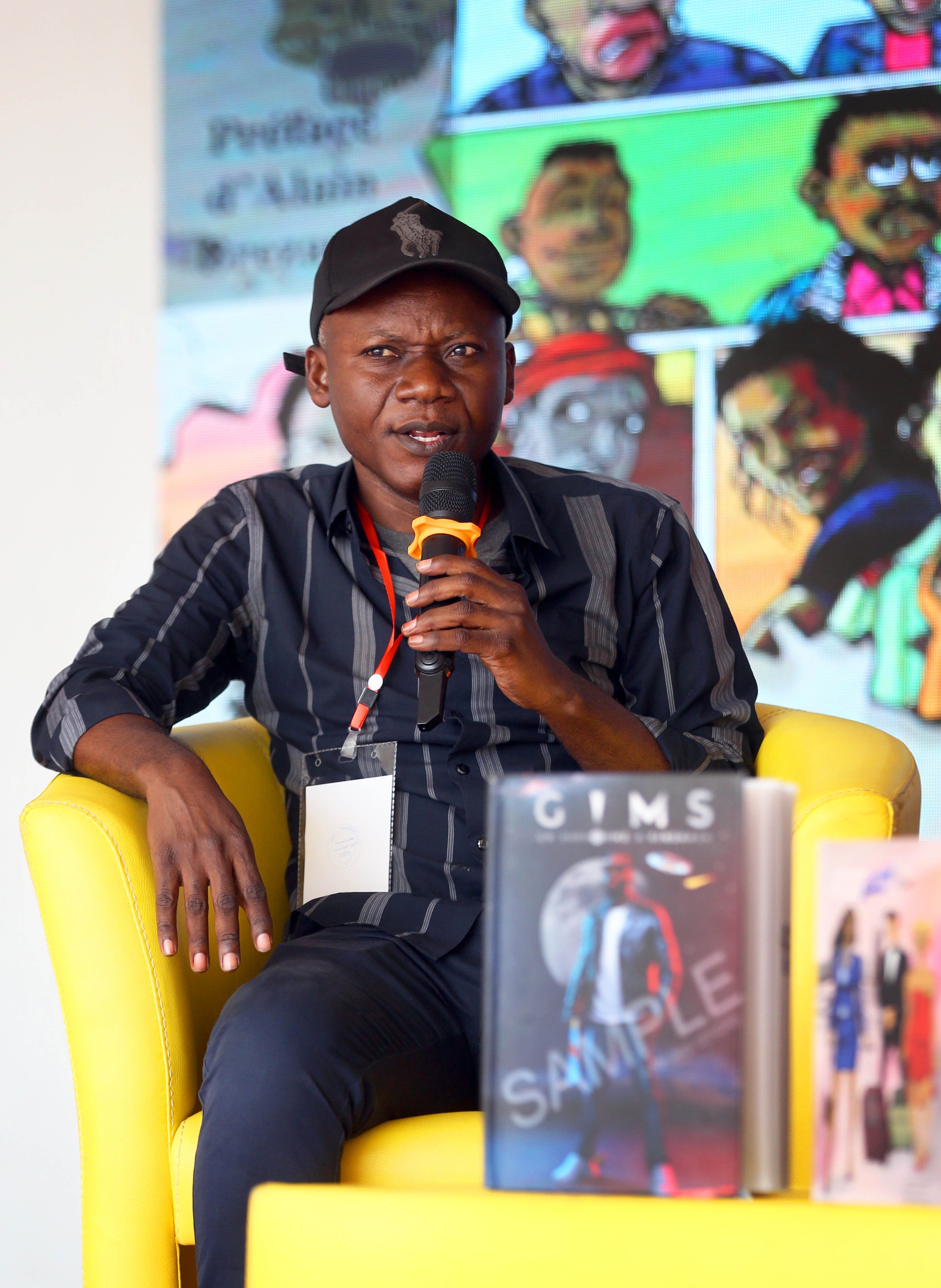
Congolese comics were at the heart of a discussion held on Sunday, October 4, 2026, as part of the Algiers International Comics Festival (FIBDA). Invited to speak about graphic novels in the Democratic Republic of the Congo, author Jérémie Nsingi spoke about his career, the difficulties facing a market marked by the gradual disappearance of publishers and bookstores, as well as the solutions developed by a new generation of comic-book artists to keep producing and reaching audiences.
"I am a Congolese comic-book author. I have been in this field for many years," said Jérémie Nsingi, who is taking part in FIBDA for the sixth time. For him, the challenge goes beyond individual creation. "We are doing our best to keep comics alive in Africa, as they are everywhere else in the world. This is our part, our contribution to the ninth art," he said.
According to the author, Congolese comics have a long history and have had a significant influence on the African comics scene. "Congolese comics are very important and influential in Africa because they go back many years. They have already been around for more than 100 years," he explained.
This history was shaped in particular by the influence of Franco-Belgian comics. "We were strongly influenced by Franco-Belgian comics, so by the legacy of the colonial period," he said, noting that the 1960s, 1970s and 1980s were particularly important periods for the industry.
This momentum was nevertheless disrupted by the social and economic crises that hit the country. "When we came along, we found that the market was really full of comics, with many titles and many authors. And then, shortly afterwards, there were the looting incidents," Jérémie Nsingi recalled. "Many bookstores closed, and many publishers also stopped operating because comics were no longer selling well as a result of the crisis."
His generation therefore found itself facing a market almost entirely lacking professional structures. "We were faced with this challenge: there were no publishers, no booksellers, there was nothing. We only had talented artists, that was it," he summed up.
Faced with the high cost of printing in Kinshasa, the authors initially tried to produce their work using their own resources. "We started by doing small print runs with local printers, but it cost us too much," he explained. The solution eventually came from China, where lower printing costs allowed him to offer books at more affordable prices.
"I discovered that printing houses there were much cheaper and that we could print at a lower cost. Even shipping these comics to Congo was still cheaper by sea," he said.
This arrangement enabled him to put albums on the market at prices suited to local purchasing power. "We could resell them at a very low price, so they were well adapted to the purchasing power of our population," he said.
The experience then extended beyond the DRC's borders. "Many African artists from the Republic of the Congo, Cameroon and Côte d'Ivoire have approached me so that I can also show them the way to improve their quality," he said.
From Biochemistry to Drawing
Jérémie Nsingi did not receive formal training at an art school. Passionate about drawing since childhood, he nevertheless pursued a different path under the influence of his family. "My father wanted me to become a doctor," he recalled. He therefore went into biochemistry before radically changing direction after completing his state examinations.
"I said to myself: why should I spend many more years studying medicine when I could make a living from my drawing? That's when I said no, I'm stopping everything, and I devoted myself to drawing," he explained.
His first publishing experiences date back to the small popular comic books of Kinshasa. He produced three editions featuring stories inspired by everyday life in Congo. His work subsequently attracted the attention of organizations that commissioned him to produce comics and brochures dealing in particular with tolerance, human rights and AIDS prevention.
One of the highlights of the discussion was the project he worked on with Gims. Still unpublished, the project was presented at FIBDA in sample form and is expected to be released first in Kinshasa, followed by France and Belgium.
The project dates back to 2019, when Gims' father discovered Nsingi's work at an exhibition in Kinshasa. Contact was subsequently established with the artist's family. "I prefer a comic book that talks about the realities of Congo. I am going to showcase Congo through this comic and use Gims' aura to bring the message of Congo to the whole world," the artist explained.
He then imagined Gims as a superhero. The project eventually reached the singer, who immediately showed interest. "He said: 'This is the best project I have been presented with so far,'" Jérémie Nsingi reported.
A meeting was subsequently arranged in Marrakech. "I explained the concept and everything to him," he recalled. The project has been in development ever since, with a release planned first in Kinshasa, followed by France and Belgium.
Another challenge is distribution. With the disappearance of many bookstores, Congolese authors have had to devise alternative ways of reaching their readers. "The public doesn't know where to find us, so we went to the public," Nsingi explained. Through his authors' association, he has set up mini comic-book festivals in schools.
The principle is simple, he explained. The authors approach school administrators to organize small fairs during breaks and at the end of the school day, without disrupting classes
For this generation of comic-book artists, it is a way of overcoming the lack of a distribution network while maintaining a direct connection with readers. "We have managed to work around the problem," Jérémie Nsingi said, arguing that the survival of comics also depends on their ability to go out and find their audience.
Throughout his career, from his earliest independent publications to his international projects, the Congolese author has pursued the same ambition: to produce accessible comics, improve their quality and keep the ninth art alive despite the vulnerabilities of the market.